Checking Bank Data After Eco 14.1.1
According to the developer, Eco hotfix 14.1.1 fixes a way to manipulate bank data. After the update, check account access and roles using regular player permissions. For a stable economy, you also need traceable laws, transactions and responsibilities; technical admin permissions do not replace these rules. The developer's statement comes from the official hotfix 14.1.1 from September 6, 2026.
Keep a world backup before making changes. If your community reports unexpected account balances, document the time and the affected accounts and compare existing records before you correct any values. The patch notice alone does not prove an attack on your world. Avoid a blanket reset of the economy: it could also erase correct transactions.
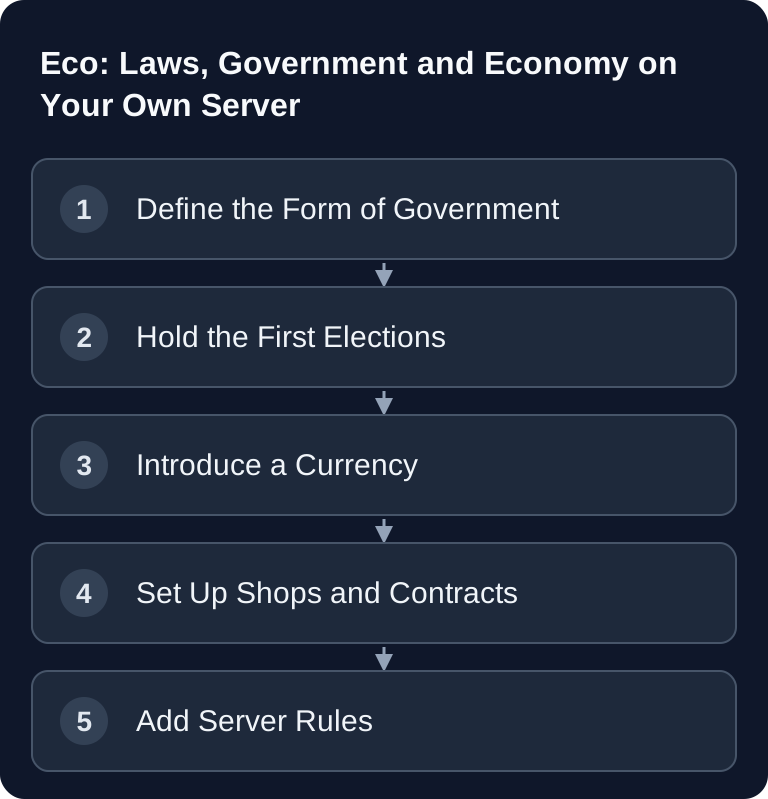
A working Eco government doesn't come from having as many laws as possible, but from an understandable constitution, traceable responsibilities and an economy that actually rewards specialization. This guide shows how your community can introduce elections, laws, currency, shops and taxes step by step, without confusing technical server rules with in-game politics.
Why Government and Economy Are the Core of Eco
Unlike pure survival titles, the civilization simulation in Eco is not an optional feature but what carries the game: without agreements on resource use, a growing community quickly ruins the shared ecosystem, and without a functioning economy, professional specialization isn't worthwhile. On your own server, you as a community decide how much political and economic structure you want to build — from a loose market economy to a full government with laws, elections and taxes.
The first part of this series covers ordering a server, choosing RAM and ports.
Back to: Setting Up an Eco Server
Forms of Government and Elections
Eco offers several forms of government that your community founds in the game itself — from direct democracy with citizen votes, through representative systems with elected officials, to specialized offices (for example for environmental protection or building regulations). Officials are determined through regular elections and can propose draft laws within their powers, without every decision requiring a server-wide vote.
For smaller communities, a simple, direct-democratic structure is often enough; larger or longer-running servers usually benefit from specialized offices, because responsibility is distributed sensibly that way.
Draft Laws and Voting
Every law enacted in Eco goes through a drafting and voting process: an official (or, depending on the form of government, any citizen) submits a draft, the community votes within a set period, and with enough approval the law takes effect. Typical laws regulate, for example, building zones, resource extraction limits to protect the ecosystem, or import/export tariffs between trade zones.
Important for server operators: these laws apply in addition to the technical server settings (see Part 1) — they are a purely in-game mechanic and do not replace moderation rules that you enforce as an admin team outside the game.
Currency: Minted vs. Credit
Eco knows two basic economic models for money:
- Minted currency: a physical coin issued and controlled by a government entity — suitable for servers with an established central government.
- Credit-based system: payments based on trust and credit without a central mint — more flexible for decentralized or early server phases in which no fixed government has formed yet.
Which model fits better depends on your community's play style; many servers switch from an informal credit system to a minted currency over the course of a round once a government has been established.
Shops and Contracts
Through shops, players offer goods and services at prices they set themselves — this is the central mechanism that makes professional specialization economically worthwhile: whoever specializes in mining sells ore to the blacksmiths instead of crafting every tool themselves. Trade contracts also allow binding agreements between players or trade zones, such as fixed delivery quantities over a period of time.
Taxes and Treasury
Once your community establishes a government, it can levy taxes on trade, land ownership or production. The collected treasury is typically used for community building projects, infrastructure or as a safety net for newcomers — you decide the specifics through the draft laws of your elected representatives.
Professions and Specialization
Eco's skill system rewards specialization: the deeper a player delves into a profession (such as farming, mining, smithing or engineering), the more efficient they become at it — while efficiency in unrelated areas drops. A functioning economy with shops and trade is the prerequisite for this specialization to actually pay off for the individual, rather than every player being forced to remain a generalist.
Server Rules for Communities
In addition to the in-game laws, a concise rule set documented outside the game is recommended for your community — for example on dealing with newcomers, resolving conflicts between economic actors, or expectations for a fair distribution of roles. You enforce these rules through your admin team; the government elected in the game is unaffected by them and regulates only what the Eco mechanics themselves represent.
Official Sources and Limits of Verification
The official Eco wiki pages on Government and Economy describe the constitution, elections, laws, taxes, shops, contracts and the two types of currency. The specific design remains a decision for your community. Introduce new rules with a clear duration at first, then check whether they have the intended effect or unintentionally block trade and newcomers.
FAQ
Does every Eco server need a government right away?
No. Small groups can start with informal agreements, shops and player credit. A formal constitution becomes worthwhile once responsibilities, public projects or binding rules can no longer be reliably settled informally.
What is the difference between player credit and minted currency?
Player credit is tied to the respective player or their shop. Minted currency creates a shared unit of account, but requires rules for issuance, distribution and the treasury. A switch should be announced and accompanied by clear exchange rules.
Do in-game laws replace moderation?
No. Eco laws control actions, fees and other game mechanics. Behavior in chat, conflict resolution or sanctions for rule violations remain the responsibility of the admin and moderation team.
How do you prevent a blocked economy?
Observe whether important goods remain available and whether new players can trade. Adjust taxes or rules one at a time, document the initial state, and give each change enough time before you evaluate its effect.
Conclusion
In Eco, government and economy are not an accessory, but the reason a community coordinates at all. With a clear form of government, a working currency system and active shops, a lively, self-organizing civilization quickly emerges on your server.
Testing a New Economic Law Before the Vote
First define exactly which action the law affects: a transaction, resource use or property. Using two regular player roles, check whether the intended action is allowed or blocked. An admin account can produce a different result because of additional permissions. Afterwards, check the tax target and the affected currency; a working shop does not guarantee a suitable treasury. Note the effective date and the expected effect before your community votes. If account balances look unexpected, record the transactions and times instead of resetting balances or the entire economy without comparison data.