Minecraft plugins use many different configuration formats and operating models. The game-serverhosting panel combines a protected file editor with dedicated assistants for common jobs: roles and permissions, WorldGuard protection, TAB, skins, VeinMiner, Chunky, voice chat and approved network services. This guide explains which interface to use and which values it actually changes.
Start with Minecraft server hosting if you still need compatible server software. Bukkit plugins normally require Paper, Purpur or another compatible implementation; a Vanilla server cannot load them.
Open the plugin browser
Open your Minecraft server and select Content → Plugins. Check the Minecraft version, server software and plugin version before installing or updating anything. The panel shows the planned file operation, dependencies and detected drift before an install, update or rollback.
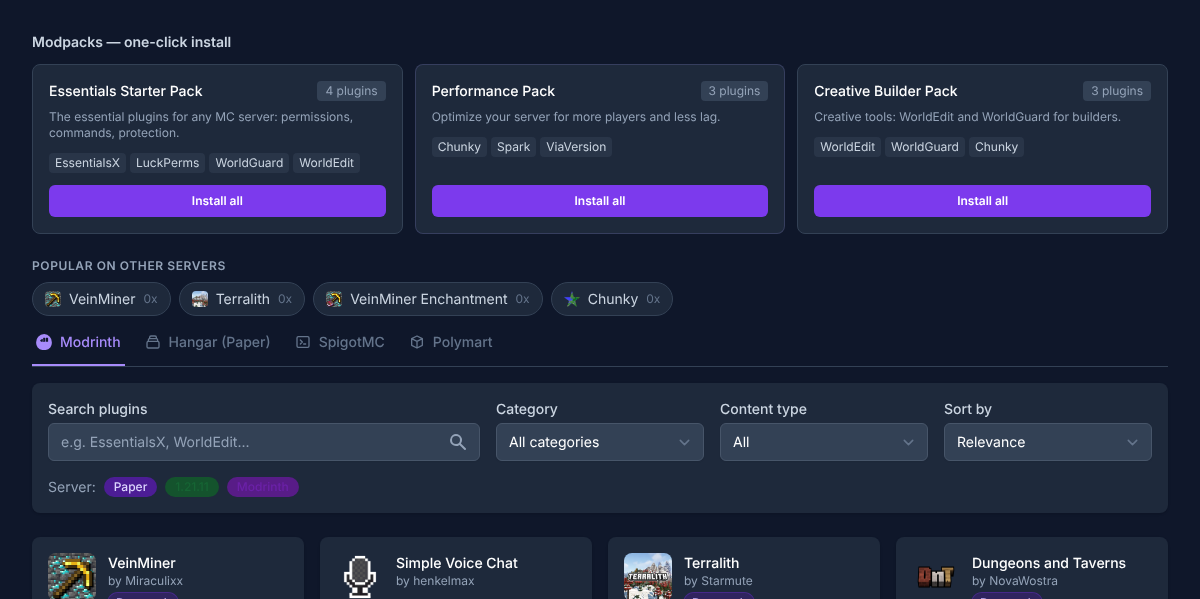
Create a backup before changing files, permissions or ports. Use a dedicated assistant when one exists because it validates plugin-specific rules. Use the generic editor for supported scalar configuration values.
Generic plugin and mod configuration editor
The editor discovers suitable configuration files for installed plugins and mods:
| Stack | Directory | Formats |
|---|---|---|
| Minecraft / Bukkit / Paper | /plugins, one subdirectory level |
YAML, YML, JSON |
| Minecraft Forge | /config, flat files or one subdirectory level |
TOML, JSON |
| Minecraft Fabric | /config, flat files or one subdirectory level |
JSON, TOML |
| Rust / uMod / Oxide | /oxide/config, flat files |
JSON |
Booleans become toggles, integers and floats become number inputs, and strings become text fields. Lists and nested objects remain read-only in the form. Files are limited to 256 KiB and must stay inside the approved root. Secret-like keys are masked and never prefilled. Raw mode may update scalar values but cannot add, remove or restructure keys. A fresh hash check prevents an old browser tab from overwriting a newer file revision.
Simple Voice Chat settings and UDP port
| Setting | Accepted value / default | Effect |
|---|---|---|
| Port | assigned dedicated UDP allocation | Written automatically; arbitrary ports are rejected |
max_voice_distance |
1–512, default 48 | Normal maximum hearing distance |
whisper_distance |
1 to maximum distance, default 24 | Hearing distance while whispering |
codec |
VOIP, AUDIO, RESTRICTED_LOWDELAY |
Audio codec profile |
enable_groups |
true | Enables voice groups |
allow_recording |
true | Allows recording features |
force_voice_chat |
false | Requires players to use voice chat when enabled |
The assistant reports ready only when the plugin is active, a UDP allocation exists and the configured port matches it. This is not a microphone or external UDP reachability test.
LuckPerms, EssentialsX, WorldEdit and WorldGuard roles
The starter-role template requires LuckPerms and EssentialsX. default receives spawn, home, TPA, messages, rules, MOTD, player list and help. moderator inherits default and adds kick, mute, ban, temp-ban, broadcast, inventory inspection and SocialSpy.
The builder template additionally requires WorldEdit and WorldGuard. builder inherits default, receives WorldEdit selection tools and can manage its own WorldGuard regions and members. The LuckPerms web-editor assistant runs lp editor groups; apply the command generated by the web editor back on the server. Test every role with an account that has no OP rights.
TAB, TabTPS and SkinsRestorer
The TAB assistant sets both tabprefix and tagprefix: default uses &7, vip uses &6[VIP] &r, moderator uses &2[Mod] &r, and admin uses &c[Admin] &r. Custom group names allow lowercase letters, numbers, _ and -, with a length of 1–32 characters.
TabTPS grants tabtps.defaultdisplay to default and reloads the plugin. SkinsRestorer grants skinsrestorer.player; the assistant can set, remove or inspect the skin of a valid Minecraft player name.
WorldGuard protection and WorldEdit access
The protection assistant manages these flags on the global __global__ region: pvp, mob-spawning, mob-damage, tnt, creeper-explosion, fire-spread and fall-damage.
Each flag accepts allow, deny or default. default removes the explicit global flag and restores normal WorldGuard or game behavior. WorldEdit access is granted per validated LuckPerms group through worldedit.* = true or false. Give this broad permission only to trusted builders.
VeinMiner and Chunky
VeinMiner 1.x is detected as a datapack; the assistant provides the read-only command /function veinminer:_config. VeinMiner 2.x has Balanced and Performance presets. Balanced uses a cooldown of 20, delay 1 and chain limit 64. Performance uses cooldown 40, delay 2, chain limit 32 and merged drops. Both require sneaking and the correct tool, use search radius 1 and leave automatic updates disabled.
Chunky starts one background world pre-generation job. Its states are idle, queued, running, paused, completed, completed_partial and failed. The current default radius is 1,000 blocks. The rough storage estimate is 800 MB × (radius / 1000)²; it is a planning estimate, not a guarantee. The panel shows progress, processing rate and ETA.
Network services and configured ports
The network assistant uses a fixed allowlist, assigns an additional port and writes only the cataloged setting after checking the file hash and current state.
| Service | Port / protocol | Key | Configuration path |
|---|---|---|---|
| Plasmo Voice | automatic / UDP | host.port |
plugins/PlasmoVoice/config.toml or config/plasmovoice/config.toml |
| squaremap | 8080 / TCP | settings.internal-webserver.port |
plugins/squaremap/config.yml or config/squaremap/config.yml |
| BlueMap | 8100 / TCP | port |
plugins/BlueMap/webserver.conf or config/bluemap/webserver.conf |
| Dynmap | 8123 / TCP | webserver-port |
plugins/dynmap/configuration.txt |
| Plan Player Analytics | 8804 / TCP | Webserver.Port |
plugins/Plan/config.yml or config/Plan/config.yml |
| Votifier | 8192 / TCP | port |
Votifier, NuVotifier or VotifierPlus config |
Web maps and Plan share the exclusive customer_http group, so competing services are reported as a conflict. BlueMap also requires explicit accept-download: true. Plan login depends on HTTPS and an enabled, verified gateway publication.
Passive analysis and Minecraft client packs
Plugin analysis is read-only over 1, 6 or 24 hours. It reports up to twelve plugin names, the exact total, detected spark, CPU/RAM peak and P95 values, and curated error signals. It does not invent per-plugin resource usage.
The Minecraft client-pack assistant creates a Packwiz package for active mods. Each mod is classified as automatic, required, optional or server_only. Before building, the panel shows incompatible or non-distributable client dependencies and manages time-limited download tokens.
Test changes safely
Check that the server starts first, then test the plugin's function and finally verify permissions with a non-privileged account. For a network service, also check the protocol, assigned port and endpoint shown by the panel. Do not edit the same configuration file in parallel outside the assistant.
FAQ
Which files can the generic editor modify?
Depending on the stack, YAML/YML, JSON or TOML inside approved plugin and configuration directories. The file must be no larger than 256 KiB and pass path and structure checks.
Can an old browser tab overwrite newer edits?
No. The editor checks the file hash again before saving. If it changed, reload and reapply your edit to the current revision.
Can I publish several web maps at once?
Supported web maps and Plan compete for the customer_http publication group. The panel reports the conflict instead of silently placing several services on one route.
Are the role templates safe for every public server?
They are traceable starting points. Remove unnecessary permissions and test every group without OP rights before opening the server.
Sources and review date
Reviewed: 8 September 2026. Formats, assistants, values and limits come from the current panel implementation. Plugin-specific behavior was checked against the official project documentation: