
Since “Breach and Clear”, Rust upkeep can rise with the detected group size. Check TC authorization, lock access and the surcharge on the same structure. Recently removed permissions can still have an effect; an immediate cost comparison therefore does not prove a configuration error.
How the Additional Upkeep Arises
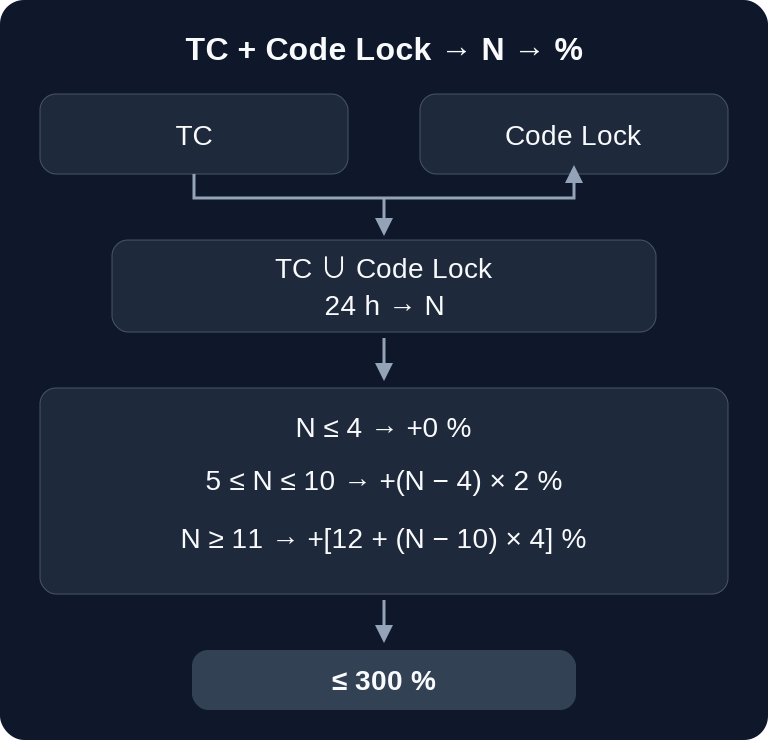
Facepunch takes TC permissions as well as code lock access, including guest access, into account. Recently removed permissions still count for up to 24 hours. The first four players cause no group surcharge, the next six add two percentage points each, and any further players add four percentage points each. The surcharge is capped at 300 percent.
| Detected players | Additional upkeep |
|---|---|
| 4 | 0 % |
| 6 | 4 % |
| 10 | 12 % |
| 12 | 20 % |
The table only calculates the group surcharge under these rules. It is not a complete material cost table for a specific base. You can see the surcharge actually applied by hovering over the upkeep costs in the opened TC.
Checking Permissions Transparently
When you have a question, first create a small before-and-after comparison: same base, same server build and same settings. Note the displayed surcharge, TC authorizations and relevant lock access. Then check whether any access was removed in the past 24 hours. Otherwise, an immediate comparison right after removal can give the false impression that the change has no effect.
Do not post access codes in public bug reports. For diagnosis, the number and type of access entries and the time of the change are enough. A group should maintain its permissions according to actual gameplay needs; switching back and forth in a short time does not make for a clean test.
What Your Players Should Know
The group surcharge mostly surprises groups that share a base but do not all play actively. Three points therefore deserve a spot in your server rules or on Discord:
- Access costs money. Every TC authorization and every code lock access counts — including guest access and also for players who have not been online for days. Anyone who wants to keep a base cheap cleans up inactive access instead of leaving it in place “for later”.
- The effect is delayed. After you remove access, it keeps counting for up to 24 hours. A look at the TC immediately afterwards still shows the old value; that is not a bug.
- The surcharge is capped. At 300 percent the maximum is reached — beyond a certain point, a very large group does not pay proportionally more.
Every player can read the value actually applied for themselves: open the TC and hover the mouse pointer over the upkeep costs. For questions, this display is the reliable source — not a recalculated table.
Reconcile Your Own Server Rules and Plugins
Facepunch lists adjustable ConVars in the Decay class, including a way to turn it off. Check the parameters actually available in your build and document every deviation from the default. Do not take over guessed keys from older guides.
- Back up the configuration and the working plugin state.
- Note all extensions that manage decay, building costs, TCs or groups.
- On a test copy, first compare the default behavior using the same base.
- Then enable exactly one custom rule or extension and repeat the comparison.
- Adopt the verified setting and describe it clearly in your server rules.
Several simultaneous multipliers make diagnosis harder. Therefore, do not change group settings, plugin configuration and base layout at the same time.
What Has Also Counted Since the August Update
Power Trip introduced a fixed upkeep of 20 percent for high external walls. This difference and the new group surcharge can coincide on the same base. Treat them as separate influencing factors and compare the material costs actually displayed before reporting a bug.
FAQ
Why doesn't the surcharge drop immediately after removing a player?
Recently revoked TC and lock permissions can still be taken into account for 24 hours. Check this period as well as remaining access.
Do I have to wipe the world for this?
A changed upkeep value alone is no reason for an additional manual wipe. First clarify build, permissions and configuration; a wipe is no substitute for this diagnosis.
Can a plugin change the displayed costs?
Check this for the extension you actually use. Compare its documented influence with a test without that extension before attributing the result to the base software.
Does guest access on the code lock count?
Yes. Facepunch takes code lock access, including guest access, into account, not just TC authorizations. If you want to keep the detected group size small, you have to keep an eye on both kinds of access.
At what group size does it get expensive?
The first four detected players cost no surcharge. After that, six players add two percentage points each, and every further one adds four. A group of ten therefore sits at about twelve percent, a group of twelve at about twenty.
Can I turn off the group surcharge on my server?
Facepunch lists adjustable ConVars in the Decay class, including a way to turn it off. You check which parameters your build actually knows on a test copy — do not take over guessed keys from older guides, and document every deviation from the default in your server rules.
Primary Sources
Telling a Group Surcharge Apart from Base Expansion
For the same base, note the building material, displayed upkeep costs and group surcharge before the change. Then change only the relevant permission and record the time. If building parts are upgraded or new structures attached at the same time, a cost difference cannot be attributed to group size alone. Also check mods and server-side decay values before you suspect a developer bug. Wait out the documented aftereffect period and compare again. A wipe is unnecessary for this test; keep the base and first investigate the access that is actually in effect.
 (Enlarge image)
