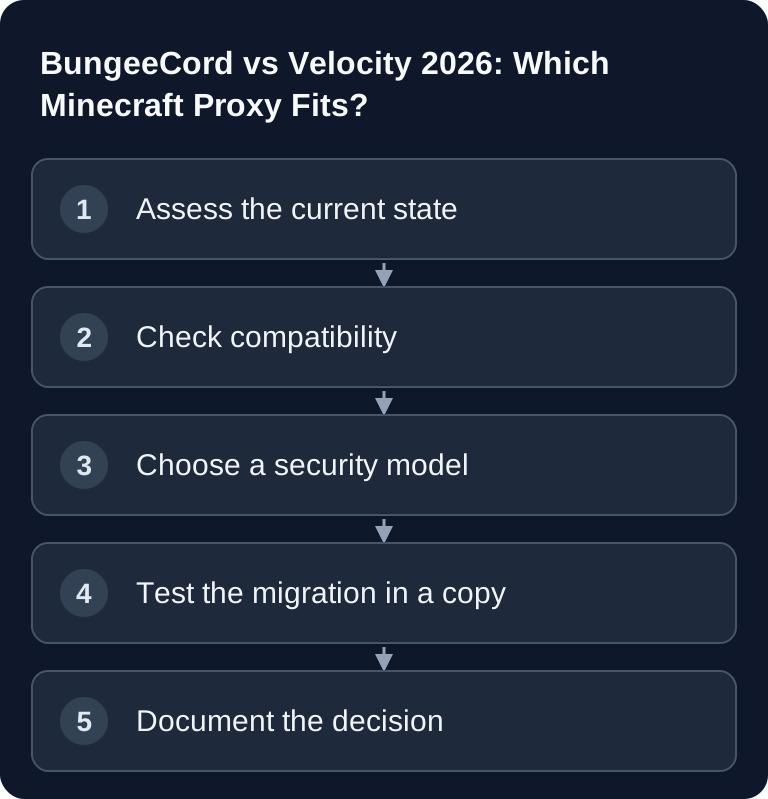
Choose your Minecraft proxy based on backend versions, forwarding and indispensable plugins. Velocity is a suitable starting point for new, current Paper networks; BungeeCord can remain sensible for existing dependencies. Test the switch on a test network instead of deriving compatibility from a general recommendation.
PaperMC explicitly recommends Velocity. This recommendation comes from the provider and maintainer of Velocity; its own comparison page itself points out possible bias. BungeeCord has not been discontinued: the repository and Jenkins still received commits and successful builds in 2026. Waterfall, PaperMC's former BungeeCord fork, on the other hand, is end of life.
Comparison at a glance
| Criterion | BungeeCord | Velocity |
|---|---|---|
| existing BungeeCord plugins | native | not generally compatible; check each plugin |
| Legacy Minecraft | broad historical compatibility | Modern Forwarding only from 1.13; legacy modes possible |
| secure native forwarding | legacy format without its own MAC secret | Modern Forwarding with secret/MAC |
| BungeeGuard | additional protection possible | BungeeGuard mode possible, Modern usually preferable |
| new Paper networks | functional, needs strict network protection | PaperMC recommendation |
| Waterfall migration | close API, but Waterfall is EOL | own proxy/API, check migration |
| Proxy plugins | BungeeCord API | Velocity API |
No entry promises a blanket player count or a performance factor. Such numbers depend on hardware, compression, plugins, protocols and connection profile and require a reproducible load test.
Forwarding and security
BungeeCord legacy forwarding transmits IP, UUID and profile information, but has no proxy-specific signature secret. That's why an offline-mode backend must be reachable exclusively from the correct proxy. BungeeGuard can add a secret; at least version 1.4.0 is required, and after an affected upgrade the token is rotated.
Velocity Modern Forwarding signs the forwarded information with a shared secret. This makes a forged proxy identity significantly harder, but doesn't replace a clean network boundary. A backend port shouldn't be unnecessarily public here either.
The official Paper documentation classifies the modes like this: Modern is more secure, BungeeGuard is better than plain legacy, Legacy is more compatible but less secure. Below Minecraft 1.13, Modern Forwarding is not available.
When BungeeCord is the sensible choice
- The running network uses central BungeeCord plugins without a verified Velocity replacement.
- Old Minecraft/mod loader versions are business-critical.
- The team masters the existing configuration and the backend network protection is demonstrably effective.
- A migration would endanger UUIDs, permissions or plugin messaging without a sufficient test path.
In that case, “stay and harden” is better than an untested modernization. Use the BungeeCord setup pillar, the config.yml reference and the forwarding security guide.
When Velocity is the sensible choice
- You're building a new network on current Paper versions.
- All required proxy plugins exist for Velocity or can be replaced.
- Modern Forwarding is compatible with all backends.
- You want a modern API and can fully test the migration in a copy.
Fabric and Forge need a version-exact check. The statement “Velocity supports mods better” is not a free pass for every loader/Minecraft combination.
Migration checklist BungeeCord → Velocity
- Create a tested backup of the proxy configuration, plugins, databases and backend playerdata. Use the backup/rollback path for this.
- Inventory all proxy plugins and mark them “Velocity native”, “replacement”, “no longer needed” or “blocker”.
- Transfer server list, listeners, forced hosts and permissions deliberately; don't blindly copy Bungee YAML into
velocity.toml. - Generate the Modern Forwarding secret on the target system and treat it like a password.
- Configure Paper or the appropriate mod loader for exactly one forwarding mode.
- Test online UUID, real client IP, skins, permissions, plugin messaging, lobby, server switching and fallback.
- Test a wrong secret path and independent direct access as negative cases.
- Check domain/SRV and Geyser/Floodgate separately.
- Keep the BungeeCord rollback ready until production joins are stable.
Plugins and operation
BungeeCord plugins don't automatically run on Velocity. Even compatibility layers are no substitute for explicit approval. When installing plugins, check platform, current version, dependencies, data migration and security notices.
A proxy restart disconnects players but doesn't restart the backends. For both proxies, plan maintenance windows, back up configuration/plugins and monitor process, TCP, Minecraft ping and a real lobby join separately.
Decision
| Starting point | Recommendation |
|---|---|
| new, current Paper network | evaluate Velocity with Modern Forwarding first |
| existing BungeeCord network with critical plugins | keep and secure BungeeCord, test migration separately |
| Waterfall | plan a replacement; project is EOL |
| Minecraft before 1.13 | check compatibility in detail; Modern Forwarding is unavailable |
| unclear plugin situation | inventory and copy test first, no production migration yet |
In both cases the domain points to the proxy; the domain/SRV guide stays the same. If you want to rebuild the instances, start at the Minecraft server order page.
FAQ
Which proxy should I use for a new network?
On current Paper versions, Velocity is the stronger starting point, mainly because of Modern Forwarding with secret and MAC. When weighing this, keep in mind that the recommendation comes from PaperMC, i.e. the maintainer of Velocity — its own comparison page itself points out possible bias.
Has BungeeCord been discontinued?
No. The repository and build server still showed commits and successful builds in 2026. What has been discontinued is Waterfall, PaperMC's former BungeeCord fork — if you're still using it, you should plan a replacement.
Will my BungeeCord plugins keep working on Velocity?
Not in general. Velocity has its own API; compatibility layers are no substitute for explicit approval of the plugin. Before a migration, inventory every proxy plugin and mark it as natively available, replaceable, dispensable or blocker.
Can Velocity handle more concurrent players?
There is no blanket number or factor. The limit depends on hardware, compression, plugins, protocol versions and connection profile. If you need a reliable statement for your network, measure it with a reproducible load test.
What applies to Minecraft versions before 1.13?
Modern Forwarding is not available there. For such cases Velocity offers legacy and BungeeGuard modes, but the security gain over BungeeCord is then largely lost. For business-critical legacy versions, “stay and harden” is often the more sensible choice.
Primary sources
- PaperMC: Comparing with other proxies
- PaperMC: Player information forwarding
- SpigotMC/BungeeCord Repository
- BungeeGuard Security
Decide on the migration based on three pieces of evidence
Before the switch, create a list of indispensable proxy plugins and confirm a suitable Velocity version or another solution for each. Then check whether each backend supports the planned forwarding mode. Finally, test a known player including inventory, permissions and backend switching. A successful login alone doesn't confirm an unchanged UUID mapping. Keep the old proxy configuration and back up external databases separately. If a necessary plugin is missing or data mappings differ, solve that dependency first; a proxy switch shouldn't introduce new world, login and permission concepts at the same time.